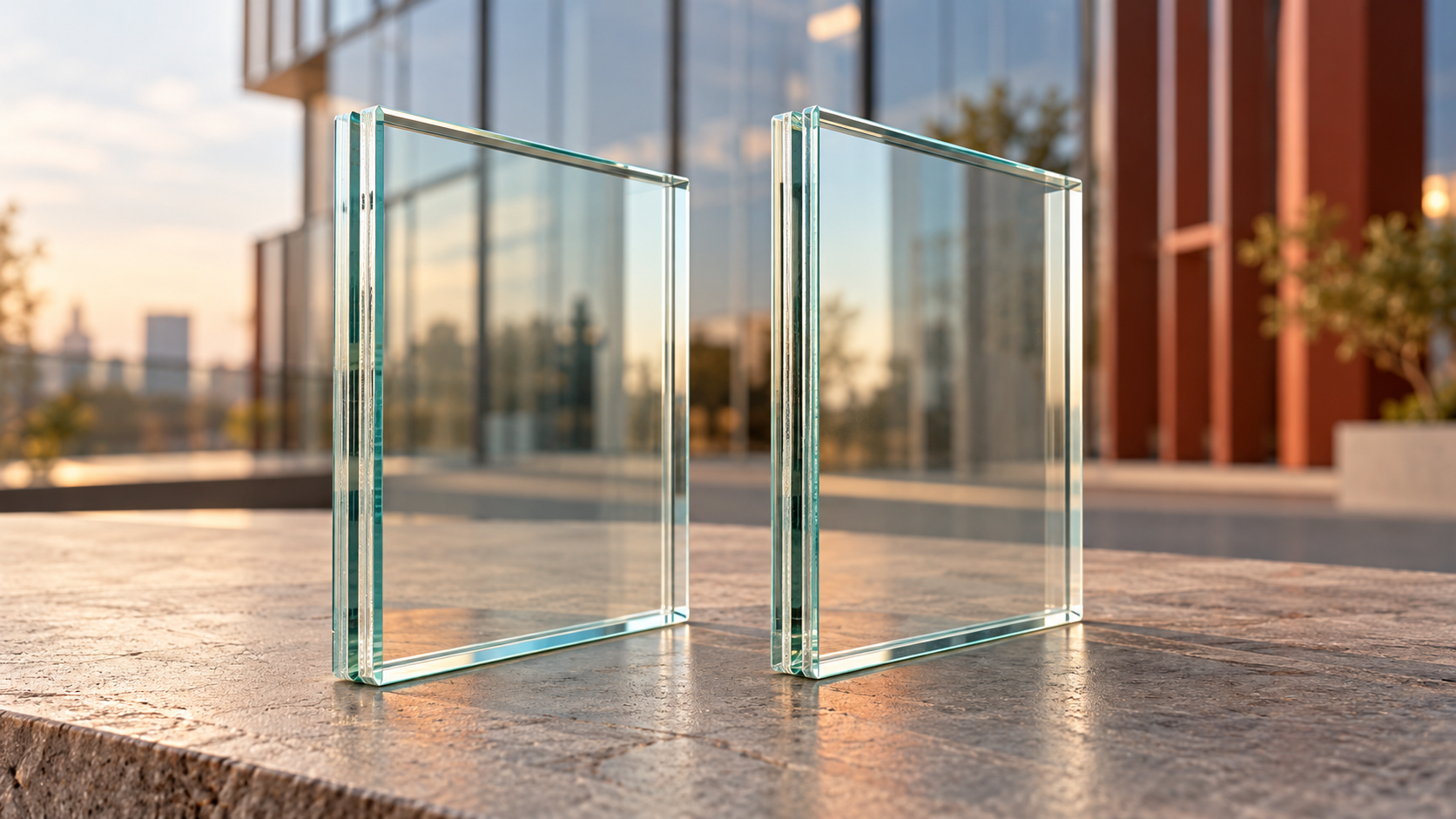
PVB and SGP are interlayers used in laminated glass, but they behave differently. PVB is widely used for safety and acoustic glazing in many standard applications. SGP is stiffer and can be considered for demanding structural or exposed applications, depending on the complete glazing design and engineer or system requirements.
PVB vs SGP is an important consideration when specifying laminated glass for modern architectural projects. Both PVB and SGP interlayers provide safety and glass-fragment retention, but their performance characteristics are different.
For standard windows and acoustic glazing, PVB laminated glass is often an effective and economical choice. For demanding architectural applications, the right choice depends on the complete glazing design, including structural requirements, acoustic performance, environmental exposure, edge conditions and cost. So, what is the difference between PVB and SGP? Which is better for structural glazing? Which is better for acoustic insulation? And when should architects and facade consultants choose one over the other? Let’s take a closer look.
What Is Laminated Glass?
Before comparing PVB vs SGP, it is important to understand laminated glass. Laminated glass consists of two or more glass panes bonded together with an interlayer. The interlayer helps hold the glass fragments together if the glass breaks, improving safety and maintaining a barrier within the opening. The type of interlayer can significantly influence the performance of the finished laminated glass.
- PVB – Polyvinyl Butyral
- SGP – SentryGlas / ionoplast interlayer
Although both are used to manufacture laminated safety glass, they are not interchangeable in every application.
PVB vs SGP: What Is the Difference?
The simplest way to understand the difference between PVB and SGP is to look at their material and mechanical behaviour.
PVB is comparatively flexible, while SGP is significantly stiffer. SGP is an ionoplast interlayer developed for high-performance laminated glass applications.
Kuraray, the manufacturer of SentryGlas, states that SentryGlas can provide up to 100 times the stiffness and five times the tear strength of conventional PVB, depending on the comparison and test conditions.
However, interlayer stiffness is only one part of the engineering decision. PVB has its own important advantages, particularly flexibility, adhesion, acoustic performance and predictable mechanical behaviour when appropriately specified.
PVB: flexible, versatile, highly adhesive and strong in acoustic applications. SGP: highly stiff, high-performance and useful where stiffness and residual shape retention are priorities
PVB Laminated Glass: Where Does It Work Best?
PVB (Polyvinyl Butyral) has been widely used in laminated safety glass for decades. Its flexibility, adhesion and availability make it suitable for a wide range of architectural applications.
Common applications of PVB laminated glass include:
- Residential windows
- Commercial windows
- Curtain walls
- Facades
- Interior partitions
- Safety glazing
- Acoustic glazing
- Doors and entrance systems
- Skylights and canopies
- Atriums and other architectural glazing applications
One of the major advantages of PVB is its acoustic performance. Special acoustic PVB interlayers can improve sound insulation by damping vibration within the laminated glass. This makes acoustic PVB particularly useful for buildings exposed to traffic, urban noise and other environmental sound sources.
If the primary requirement is sound reduction, an appropriately specified acoustic PVB system may be preferable.
PVB vs SGP for Structural Glazing
Structural glazing requires the complete laminated glass assembly to be considered-not simply the interlayer in isolation. The glass may need to resist wind, dead, impact and other design loads, while also meeting requirements for safety, durability, deflection and post-breakage behaviour.
Although SGP is substantially stiffer than conventional PVB, PVB laminated glass can also be highly suitable for structural architectural applications when the complete glazing system is properly engineered and specified.
One of the standout qualities of PVB laminated glass is its strength and its ability to perform as part of a carefully designed structural glazing system. PVB offers flexibility, adhesion and resistance to impact, heat and corrosion. These properties can make it suitable for applications such as skylights, canopies, atriums and facades.
PVB’s low dielectric constant and high flexibility can add to its appeal in structural applications. Its excellent adhesion properties also allow it to bond effectively to various substrates, creating additional design and detailing possibilities.
Another important advantage is the predictability of PVB’s mechanical properties. When the complete glass build-up, temperature, loading, dimensions and support conditions are known, engineers can assess and forecast the behaviour of the laminated glass for the intended application. SGP remains valuable where very high interlayer stiffness, reduced deflection, exposed edges or strong post-breakage shape retention are priorities. Therefore, PVB can be a strong structural glazing solution, while SGP offers specific advantages where high stiffness is the controlling requirement.
Potential PVB structural applications include:
- Skylights
- Canopies
- Atriums
- Facades
- Large architectural glazing
- Structural glass elements, subject to engineering design
- Applications where flexibility, adhesion and predictable behaviour are important
For structural glazing: do not choose an interlayer on stiffness alone. Evaluate the complete glass build-up, loads, support conditions, temperature, edge conditions, durability and applicable standards.
PVB vs SGP: Performance Comparison
| Performance factor | PVB laminated glass | SGP laminated glass |
|---|---|---|
| Interlayer type | Polyvinyl Butyral | Ionoplast |
| Flexibility | Higher | Lower |
| Structural use | Can be suitable when the complete system is properly engineered | Particularly useful where high interlayer stiffness is required |
| Post-breakage behaviour | Retains broken glass; performance depends on the complete system | Strong shape retention and residual strength |
| Acoustic performance | Strong advantage, especially with acoustic grades | Generally not the primary selection criterion |
| Adhesion | Excellent adhesion properties | High-performance structural interlayer |
| UV protection | Can filter up to 99% of the most damaging portion of the UV spectrum, depending on the interlayer | Performance depends on product/system specification |
| Edge exposure | Requires appropriate protection/detailing | Well suited to exposed-edge applications |
| Cost | Generally lower | Generally higher |
| Typical applications | Windows, facades, acoustic glazing, skylights, canopies, atriums | Balustrades, canopies, structural glazing, overhead glazing, demanding high-stiffness applications |
The important point is that neither interlayer is automatically the best choice for every project. The appropriate interlayer depends on the performance requirements of the complete glazing system.
PVB’s Additional Architectural Advantages
PVB laminated glass offers more than glass-fragment retention. Its interlayer can also influence the internal environment and the long-term protection of building interiors.
Depending on the interlayer specification, PVB can filter up to 99% of the most damaging portion of the UV spectrum. Reducing UV exposure can help reduce fading of interior finishes, artwork, wood flooring and furnishings.
This UV filtration can contribute to a more comfortable and protected interior environment, particularly in spaces with large areas of naturally lit glazing.
PVB also offers significant sound-abatement benefits. By damping vibration and reducing sound transmission, laminated glass with an appropriate PVB interlayer can help create quieter interior spaces.
Different glass thicknesses and interlayer combinations can be selected to address specific acoustic requirements, while the airspace within insulated glass units can contribute further to sound attenuation.
PVB vs SGP for Acoustic Glass
If the primary objective is acoustic insulation, the comparison changes.
The flexibility and damping characteristics of PVB make acoustic PVB a strong option for reducing sound transmission. This is why acoustic laminated glass with PVB is commonly considered for:
- Residential buildings
- Hotels
- Offices
- Hospitals
- Buildings near highways
- Buildings near airports
- Urban developments
SGP, on the other hand, is primarily selected for stiffness, structural performance and durability rather than acoustic damping.
For acoustic performance: consider acoustic PVB. For high interlayer stiffness: consider SGP.
PVB vs SGP After Glass Breakage
Post-breakage behaviour is another important factor when comparing PVB vs SGP laminated glass. Both interlayers help retain broken glass. SGP’s higher stiffness can help a broken laminated glass panel retain greater shape and residual structural capacity.
PVB also provides important fragment-retention and safety benefits. The actual post-breakage performance of either system depends on the complete glass build-up, support conditions, loading and application.
- Glass balustrade: post-breakage stability matters
- Overhead glazing: fragment retention and residual performance matter
- Structural glazing: stiffness, load response and the complete system matter
In applications where very high stiffness and residual shape retention are critical, SGP may offer advantages. In other architectural applications, properly engineered PVB can provide an effective balance of safety, flexibility, adhesion and performance.
PVB vs SGP: Which Is More Durable?
Another important consideration is edge exposure and moisture resistance.
Laminated glass can be particularly vulnerable at its edges if the wrong edge conditions, drainage, sealing or installation details are used.
SGP’s lower moisture sensitivity makes it attractive for applications involving exposed glass edges and demanding environmental conditions.
PVB can also perform reliably when the glazing system is appropriately designed, fabricated, protected and installed. Choosing either interlayer does not eliminate the need for good detailing.
Glass edge protection, drainage, sealants, fabrication quality and installation remain critical to long-term performance.
PVB vs SGP: Which One Costs More?
In general, SGP laminated glass costs more than conventional PVB laminated glass.
This is one reason PVB remains an attractive solution for many standard and architectural glazing applications.
But the lowest material price does not necessarily mean the lowest overall project cost. If a particular interlayer allows the project to meet its performance requirements with a more efficient glass configuration, its higher material cost may be justified. Therefore, the right approach is to evaluate performance, glass thickness, structural requirements, durability, installation and lifecycle requirements rather than comparing the interlayer price alone.
Is SGP Stronger Than PVB?
In key mechanical properties, SGP is significantly stiffer and has substantially higher tear strength than conventional PVB.
Kuraray states that SentryGlas can provide up to approximately 5x the tear strength and 100x the stiffness of conventional PVB, depending on the test or property being compared. “5x tear strength” or “100x stiffness” describes specific interlayer properties, not a universal strength multiplier for the finished glass panel.
The performance of a finished laminated glass panel depends on:
- Glass thickness
- Number of glass plies
- Interlayer thickness
- Panel dimensions
- Support conditions
- Temperature
- Loading
- Glass type
- Edge conditions
The complete glass build-up must therefore be engineered for the actual application.
PVB or SGP: Which Should You Choose?
Choose PVB when:
- You need general safety glazing
- Acoustic performance is important
- The glass is used in conventional windows or facades
- Flexibility and adhesion are important
- Skylights, canopies or atriums require a properly engineered laminated glass solution
- Predictable mechanical behaviour is important to the design
- UV filtration and interior-finish protection are valuable
- Cost efficiency is important
Consider SGP when:
- Very high interlayer stiffness is required
- Structural glazing demands greater stiffness
- Large glass panels require high rigidity
- Post-breakage shape retention is critical
- The glass has an exposed edge
- The application involves canopies or overhead glazing where the design specifically benefits from ionoplast stiffness
- High-performance balustrades or glass railings require the characteristics of SGP
The final choice should always be based on the complete glazing system, including glass thickness, interlayer thickness, dimensions, support conditions, wind loads, impact requirements, environmental exposure and applicable standards.
PVB vs SGP: The Final Verdict
There is no universal winner in the PVB vs SGP comparison.
PVB remains a highly versatile laminated-glass solution, offering safety, flexibility, adhesion, acoustic performance, UV filtration and predictable mechanical behaviour. When properly engineered, it can be used in demanding architectural and structural applications including facades, skylights, canopies and atriums.
SGP offers significantly greater interlayer stiffness and tear strength and can be particularly valuable where structural stiffness, post-breakage shape retention and exposed-edge performance are important.
The smartest specification is therefore not simply “Choose the stronger interlayer.” It is “Choose the interlayer that best meets the project’s actual performance requirements.”
For architects, facade consultants, developers and contractors, understanding the differences between PVB laminated glass and SGP laminated glass can help achieve the right balance between safety, structural performance, acoustic comfort, durability, design flexibility and cost.
FAQ
What is PVB in laminated glass?
PVB is a common laminated glass interlayer used for safety, glass-fragment retention, and acoustic applications.
What is SGP glass interlayer?
SGP is a stiffer laminated glass interlayer used in selected demanding architectural and structural glazing applications.
Is SGP always better than PVB?
No. SGP is not automatically required for every project. The right interlayer depends on performance requirements and design conditions.
Where is PVB commonly used?
PVB is commonly used in windows, doors, safety glazing, acoustic glazing, and many standard architectural applications.
Who should specify PVB or SGP?
The project architect, facade consultant, structural engineer, or glazing specialist should specify it based on load, safety, exposure, edge conditions, and system design.